

Key Events: Energy disruption forcing bold action
The International Energy Agency (IEA) announced an unprecedented stockpile release of 400-million-barrels to reduce oil price pressure from the closure of the Strait of Hormuz.1 On Friday, President Trump announced that the US had struck military targets on the Kharg Island and threatened additional attacks if Tehran interferes with transit through the Strait.
In addition to the war, private credit concerns have continued to mount as Cliffwater capped redemptions and JP Morgan marked down some private loans.2
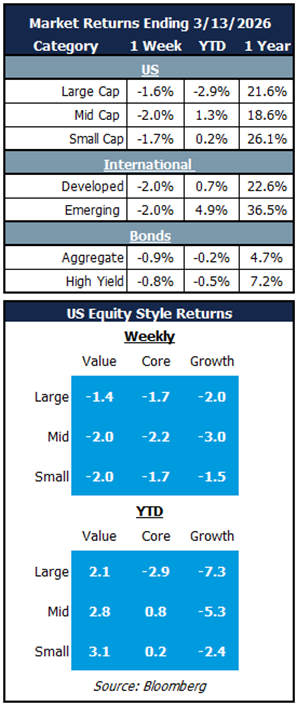
Market Review: Mideast war drives risk-off retreat
Continuation of war in the Middle East has led to pronounced production cuts by several countries due to closure of the Strait of Hormuz. Global equities retreated in lock-step as risk-off sentiment prevailed. Bonds weakened further on stagflation concerns.
Outlook: Iran War length key to market outlook
The energy crisis is having such an impact on the global economy that the IEA believes the war is “creating the largest supply disruption in the history of the global oil market”.3 The repercussions have been particularly challenging for Asian consumers which rely heavily on oil produced in the Middle East. The key to various scenarios moving forward is the timeframe for conflict resolution and re-opening of the Strait of Hormuz.
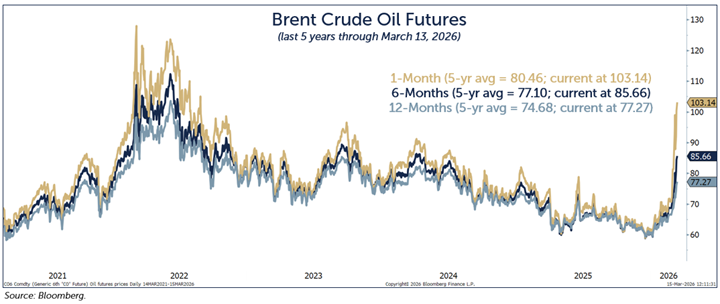
Oil price futures for 6-months and 12-months suggest an end to war in Iran over the next 4-6 weeks remains a somewhat likely scenario.4 12-month Brent crude futures closed Friday less than 5% above the 5-year average. This may explain why global stocks have not sold off more; however, the war is ongoing and futures prices continued to rise last week.
While there is still uncertainty over timing of a resolution, the spread between the 1-month and 12-month Brent futures is currently larger than at any time during the oil spike in 2022 and the narrowing of the spread over the next several months should provide significant relief to the global economy. In the meantime, consumers should take comfort in the fact that energy costs have become far less impactful to the consumer basket as depicted in the lower chart.
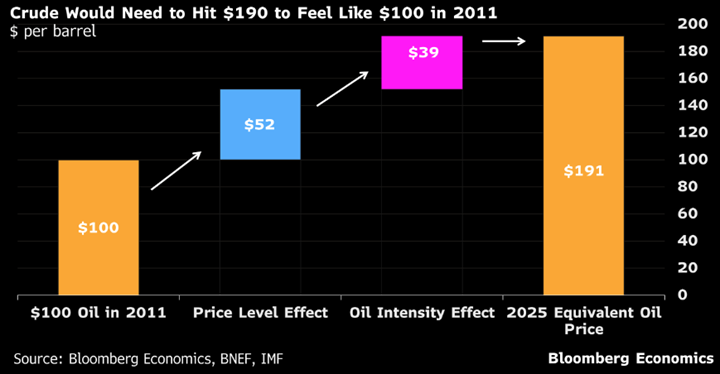
Oil intensity to GDP has declined significantly over the past 15 years and oil prices have not kept up with inflation.5 As a result, the price of oil would have to rise to $191 today to have the same impact on consumers that it would have posed at $100 in 2011.6 The current oil price and the volatility of daily pricing may be today’s concern for markets, but tomorrow’s opportunity relies on a resumption of oil flowing again from the Middle East and a normalized relationship between current and longer dated oil futures.
While many different scenarios could still unfold, any positive developments over the next several weeks could lead to a sharp reversal in risk assets. Investors would be wise to rely on their long-term objectives and resist the urge to react to the current chaos afflicting the global economy.
Oil Futures Are Not Anticipating Extended War in Mideast
Crude Oil Price Impact Not What it Used To Be
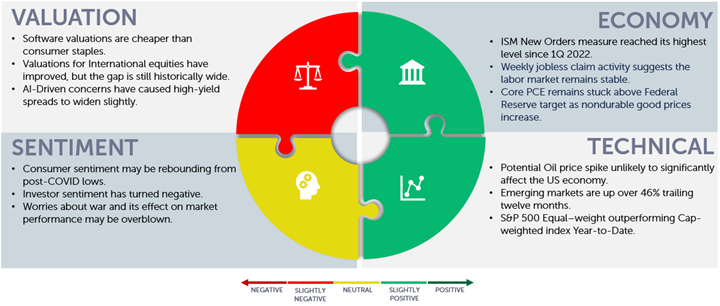
OneAscent Navigator Outlook: March 2026
This material is intended to be educational in nature , and not as a recommendation of any particular strategy, approach, product or concept for any particular advisor or client. These materials are not intended as any form of substitute for individualized investment advice. The discussion is general in nature, and therefore not intended to recommend or endorse any asset class, security, or technical aspect of any security for the purpose of allowing a reader to use the approach on their own. Before participating in any investment program or making any investment, clients as well as all other readers are encouraged to consult with their own professional advisers, including investment advisers and tax advisors. OneAscent can assist in determining a suitable investment approach for a given individual, which may or may not closely resemble the strategies outlined herein.[7]
1 Source: Bloomberg story, “Oil Market Set for Tumultuous Week as Kharg Attack Raises Stakes”.
2 Source: Multiple press reports from Bloomberg, Reuters and the Financial Times contained in Syz Weekly summary, 3/14/2026.
3 Source: Bloomberg story, “Iran War Catapults Asia to the Frontline of a Global Fuel Crisis”, dated March 15, 2026.
4 Source: A reference to a Bloomberg story, “Pentagon Sees Iran War Lasting Up to Six Weeks”, dated March 15, 2026. The story cited Kevin Hassett’s comments on Face the Nation.
5 Source: Bloomberg story, “GLOBAL INSIGHT: Why Oil at $100 Doesn’t Hurt Like It One Did”, dated March 10, 2026.
6 Source: Chart excerpted from Bloomberg story, “GLOBAL INSIGHT: Why Oil at $100 Doesn’t Hurt Like It One Did”, dated March 10, 2026.
7 Market Returns reference the following indices: Large Cap – S&P 500, Mid Cap Growth – Russell Midcap growth, Mid Cap Value – Russell Midcap Value, Small Cap – Russell 2000, Developed – MSCI EAFE, Emerging – MSCI Emerging Markets, Aggregate – Bloomberg US Aggregate, High Yield – Bloomberg High Yield
OAI01481