

Key Events: Fed speakers retain hawkish tone
Federal Reserve Bank of Chicago President Austan Goolsbee opened the week warning that the “central bank cannot ignore repeated and persistent supply shocks” and that a return “to 2% inflation may not be painless” as further rate hikes might be needed to achieve the Fed’s target.1 Several other Fed speakers also signaled additional tightening may be required.
The Trump-Xi summit in Washington concluded with an extension of the US-China trade truce into January. Rare-earth access, Taiwan and other issues remain unresolved.
Market review: Treasury yields continue to surge
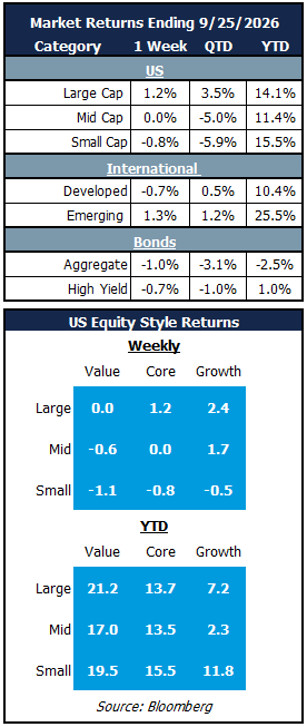
Strong S&P Global Purchasing Manager’s Index (PMI) data drove a mid-week jump that pushed the 10-year Treasury yield up 20 basis points for the week. Bonds fell, but equities showed mixed results as larger companies managed to make forward progress on the back of strength in the information technology and communications sectors.
Outlook: Higher yields reveal risk and opportunity
Rising commodity prices and higher inflation have been flagged for months as key risks to interest rates for bonds and valuations for equities. Yet inflation break-evens have held steady during the recent rise in yields. That suggests strong economic growth and heavy credit demand from booming capital investment, rather than inflation expectations, are driving both nominal and real yields higher.
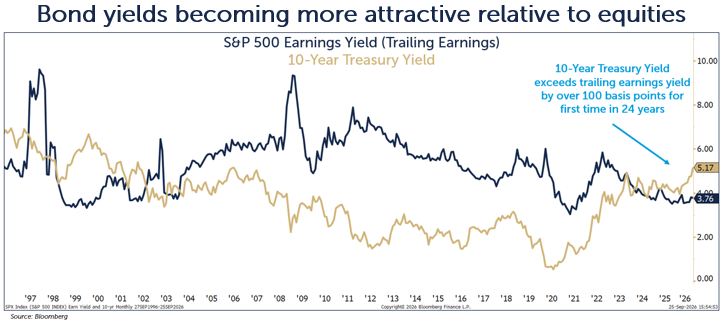
Resilient growth continues to support a strong earnings trend for equities. Even so, the 10-Year Treasury yield has moved well above the trailing earnings yield on stocks, and Treasury yields now sit at their highest level in over 19 years. With strong corporate borrowing demand and the Treasury’s ongoing need to refinance government debt, it may be early to move aggressively into fixed income. However, the widening gap above the earnings yield points to a potential opportunity for bond investors once growth shows clear signs of slowing.
Industry data suggests most multi-asset investors are significantly underweight bonds just as yields reach their highest levels in nearly two decades. A contrarian view would assert that it may be time to start reducing the underweight and move allocations back to target levels.
OneAscent Navigator Outlook: September 2026
This material is intended to be educational in nature, and not as a recommendation of any particular strategy, approach, product or concept for any particular advisor or client. These materials are not intended as any form of substitute for individualized investment advice. The discussion is general in nature, and therefore not intended to recommend or endorse any asset class, security, or technical aspect of any security for the purpose of allowing a reader to use the approach on their own. Before participating in any investment program or making any investment, clients as well as all other readers are encouraged to consult with their own professional advisers, including investment advisers and tax advisors. OneAscent can assist in determining a suitable investment approach for a given individual, which may or may not closely resemble the strategies outlined herein.2
1) Source: Bloomberg story, “Fed’s Goolsbee Says Road to 2% Inflation May Not Be Painless”, by Catarina Saraiva, 9/21/2026.
2) Market Returns reference the following indices: Large Cap – S&P 500, Mid Cap Growth – Russell Midcap growth, Mid Cap Value – Russell Midcap Value, Small Cap – Russell 2000, Developed – MSCI EAFE, Emerging – MSCI Emerging Markets, Aggregate – Bloomberg US Aggregate, High Yield – Bloomberg High Yield
OAI01616